When the same two people build thinkorswim, sell it to TD Ameritrade for a reported $606 million, then build tastytrade and sell it to IG Group in a deal valued at about $1 billion, their next move gets attention. That next move is called Lossdog.
And when Lossdog needed its earliest users, the plan did not start with a Super Bowl spot or an influencer blitz. It started at tables on college campuses, staffed by students talking to other students.
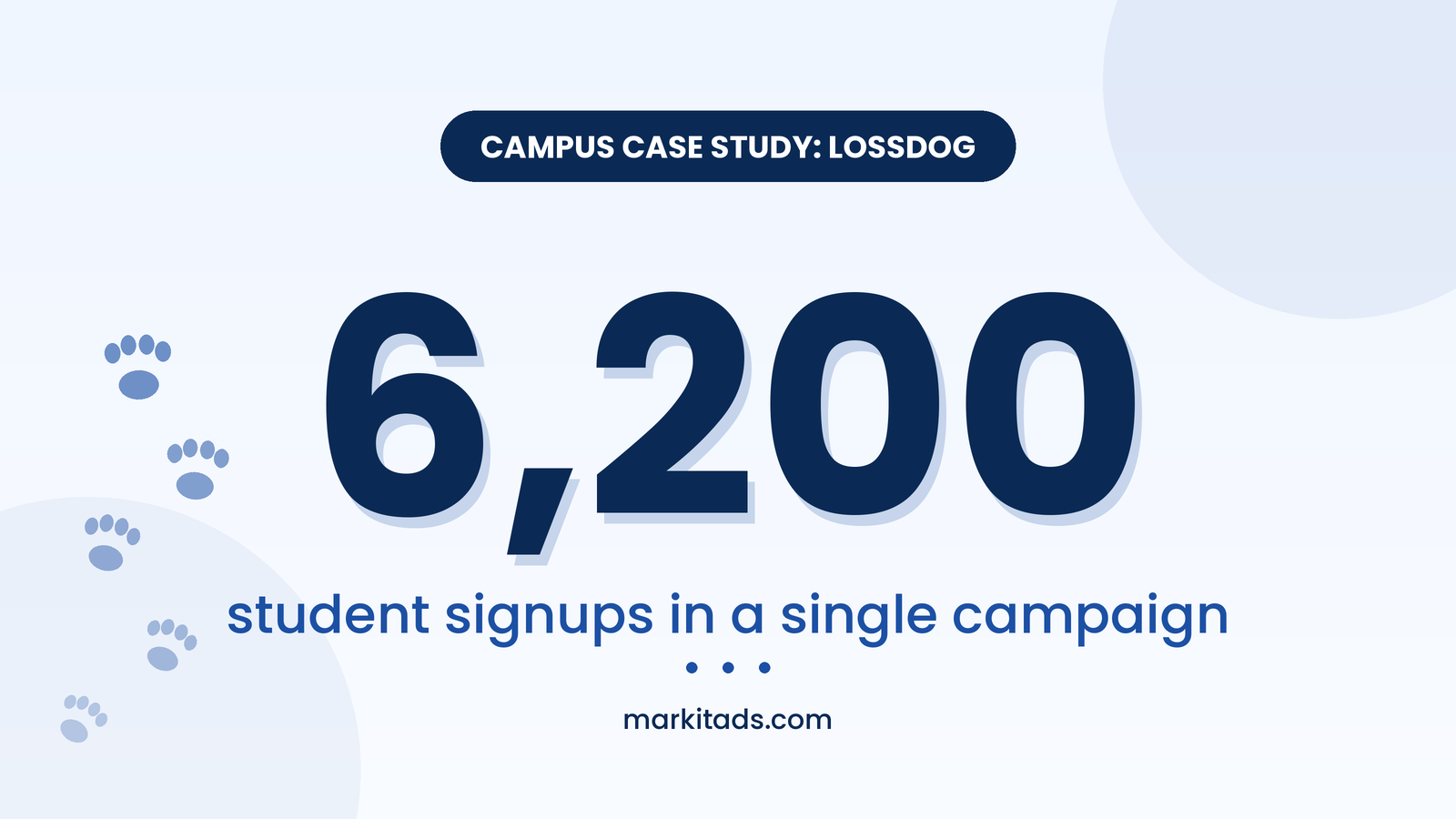
The result: 6,200 student signups from a single campaign.
This post breaks down why campus marketing keeps beating channels with ten times the budget, what MarkitU is, and how the Lossdog campaign actually worked.
Why Campus Marketing Still Wins
College students are the hardest audience in America to reach with ads. They skip pre-roll, they scroll past feeds, and they trust almost nothing that arrives through a screen. What they do trust is a person standing in front of them, especially one who goes to their school.
That is the whole thesis of campus marketing. A campus is thousands of people in the same demographic, walking the same three quads every day, influenced heavily by what their friends are doing. Put a trained peer at a table in the middle of that, and you get something no ad buy can produce: real conversations that end in real signups, on the spot.
The old knock on field marketing was that you could not measure it. That excuse is dead. Every signup in a modern campus campaign is tracked to the campus, the day, and the student ambassador who generated it. You know exactly what you paid and exactly what you got.
What MarkitU Is
MarkitU is our self-serve platform for exactly this kind of campaign. It connects brands to a network of more than 1,000 trained student ambassadors across 50+ universities, including UCLA, USC, UT Austin, Michigan, Ohio State, and UNC.
It works in three steps. You define the goal and pick your campuses. Ambassadors run the on-the-ground activations: tabling, events, peer-to-peer demos. You watch results come in on a live dashboard, with verified signups and one-click data exports. Campaigns can launch in as little as 24 hours, and there is no long-term commitment.
MarkitAds is the full-service side of the house: strategy, positioning, and campaign design, like the work in our featured projects. MarkitU is the same operator network, productized, so a growth team can run campus like any other channel. Results in days, not months.
Case Study: Lossdog
Lossdog is the new venture from Tom Sosnoff and Scott Sheridan, the co-founders of thinkorswim and tastytrade. This time the target is not options trading. It is pay. Lossdog is an AI-powered career compensation and wealth optimization platform, built to show professionals what they are actually worth and to give them the data to go get it. “People don’t fail because they lack effort or talent but because they lack visibility, leverage, and fair data,” Sosnoff said in the company’s launch announcement.
Think about who cares most about that message. Students. They are months away from their first salary negotiation, they talk about pay transparency more openly than any generation before them, and they have watched the numbers on their side of the table stay flat while everything else got more expensive.
So the audience was never in question. The question was how to reach them in a way they would believe. The answer looked simple on the surface: tables in high-traffic campus locations, staffed by trained student ambassadors who could explain Lossdog in one sentence, answer the skeptical questions, and get the signup done right there, phone in hand. Behind that simplicity sat the system: every signup tied to a campus and an ambassador, tracked and verified, visible as it happened.
The campaign delivered 6,200 signups. Not impressions. Not clicks. Accounts created by the exact people the product was built for.

A number like that changes the conversation inside a company. A head of growth does not have to defend a brand-awareness line item. They can put campus on the same scoreboard as paid social and search, with a known cost per signup, and let the channels compete. In our experience, that is a fight campus likes.
Signups Are the Start, Not the Score
One more thing, because it is the part most agencies skip. A signup is the first rung on a ladder that runs from install to signup to funded account to active user to retained user. The real test of any acquisition channel is what its users do in the 30, 60, and 90 days after they arrive. That is the standard we hold campus campaigns to, and it is why every MarkitU campaign is built around tracked, verified signups instead of vanity metrics. When you can follow the cohort, you can prove the channel.
The Playbook, If You Want It
Start with one campus. Define the metric that actually matters to your business, not the shallowest one. Put trained peers in front of students. Track every signup to its source. Then scale what works.
If you want the self-serve version, it is live at markitu.com. If you want the full-service version, talk to us. One campus. One semester. Then we let the numbers argue for us.